On This Page:
Group Reformer Pilates
Start with a $10 introductory session. Train with only two to four women and receive focused coaching in Woodbridge.
Need Help Choosing the Right Program?
Tell us about your goals, experience, and preferred training style?
Our team can help you explore Reformer Pilates, strength training, personal training, Clinical Pilates, Active Rehab, and other women’s fitness programs.

And I keep hearing the same story:
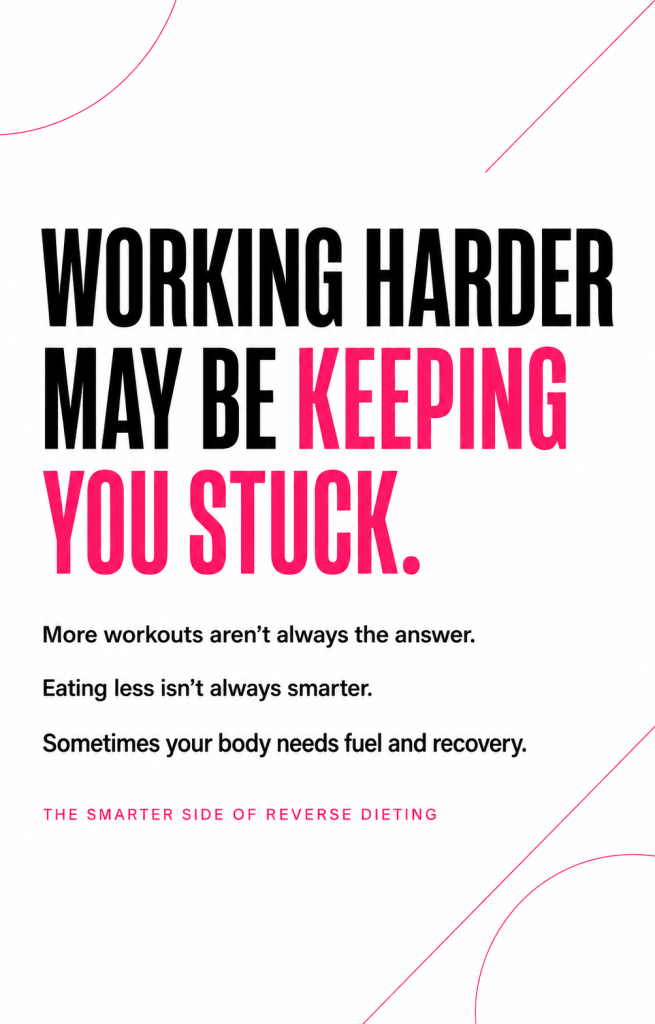
“I’m working really hard—but nothing is changing.”
These women are training three, four and sometimes five days a week. They’re walking, getting their steps in and watching what they eat.
Some track nearly everything.
But they’ve been stuck at the same weight and body composition for months. In some cases, the plateau has lasted six months or longer.
Naturally, they assume they need to do more.
Another workout.
A longer walk.
A more intense class.
Fewer carbohydrates.
Even fewer calories.
But what if working harder is actually the wrong answer?
YOUR BODY ISN’T A CALCULATOR
Your body is alive and constantly working to protect you.
Your heart beats approximately 100,000 times every day. You take somewhere between 17,000 and 29,000 breaths. Your brain is working around the clock, while your organs function, your muscles repair and your body continually regenerates itself.
All of that requires energy.
Your body also has an incredible ability to adapt. If you consistently feed it 1,400 calories while asking it to handle multiple workouts and thousands of daily steps, it will eventually become more efficient with the energy it receives.
This doesn’t mean your metabolism is broken.
It means your body has adjusted.
After losing 20, 30, 50 pounds or more, you are also living in a smaller body that naturally requires fewer calories. Prolonged dieting may further reduce resting energy expenditure, unconscious daily movement and training performance.
Eventually, the nutritional plan that originally produced results can become the plan that maintains your current weight.
And cutting calories again isn’t always the smartest solution.
WHEN MORE WORK STOPS WORKING
When progress slows, most people respond by pushing harder.
That might work temporarily, but it often creates an exhausting cycle:
Eat less. Exercise more. Lose a little. Plateau again. Repeat.
Meanwhile, energy drops, sleep suffers, workouts become less productive and recovery gets worse. Hunger and cravings may increase, while the body becomes less inclined to move throughout the rest of the day.
You’re doing more—but getting less from it.
At that point, I often introduce a recovery phase using a strategy known as reverse dieting.
WHAT IS REVERSE DIETING?
Reverse dieting is a planned and controlled increase in food intake following a prolonged calorie deficit.
We don’t suddenly abandon every healthy habit or give someone permission to eat anything she wants. We gradually increase calories while continuing to monitor body weight, measurements, strength, energy, sleep and recovery.
For example, I may begin by adding approximately 25 grams of carbohydrates per day—about 100 calories. Depending on the person, I may then increase carbohydrates again and add more protein over the following weeks.
The exact numbers are individualized. Someone who has lost a significant amount of weight and has been under-eating for months may need a different approach than someone experiencing a short-term plateau.
The goal is to find a calorie level that properly supports her body, training and lifestyle without creating unnecessary body-fat gain.
This is not a magic trick that suddenly makes calories stop counting.
It is a structured way to support recovery, improve training performance, protect or rebuild muscle and establish a healthier maintenance level.
WHY THE SCALE MAY INCREASE
This is where many women panic.
When we increase carbohydrates, the muscles begin storing more glycogen—the fuel your body uses during training. Glycogen also holds water inside the muscle.
That means the scale may rise slightly during the first week or two.
There is also more food moving through the digestive system, and changes in carbohydrate and sodium intake can influence fluid balance.
That immediate increase is not automatically body fat.
Your muscles may look fuller. You may feel stronger. Your workouts may improve. Your energy may come back—and your waist measurement may remain virtually unchanged.
This is why we don’t judge progress by one scale reading.
We look at the complete picture:
- Body measurements
- Body-fat percentage
- Muscle mass
- Strength
- Energy
- Sleep
- Hunger and cravings
- Training performance
- How your clothing fits
The scale is one piece of information. It is not the final verdict.
REBUILDING WHAT MAY HAVE BEEN LOST
When someone loses a significant amount of weight through an aggressive calorie deficit, she may lose muscle along with body fat—especially without enough protein, recovery and properly structured strength training.
That matters.
Muscle supports strength, independence, healthy ageing, training performance and long-term weight management. Losing pounds is not enough if we become weaker in the process.
A recovery phase gives us an opportunity to increase protein, improve carbohydrate availability and train with enough energy to rebuild strength and lean tissue.
For many women, that means eating three or four balanced meals, including approximately 25–40 grams of protein at each meal, while continuing progressive strength training.
This isn’t stepping away from the goal.
It is strengthening the foundation underneath it.
SUMMER DOESN’T HAVE TO BE ANOTHER DIET
We spend so much time trying to make our bodies smaller that we sometimes forget to make them healthier.
You do not have to diet aggressively twelve months of the year.
Sometimes the smartest decision is to spend a season maintaining your results, eating more nourishing food, sleeping better, rebuilding muscle and enjoying your training again.
For some women, that may mean gradually working toward 1,800 or even 2,000 calories per day. Those numbers are not excessive for an active woman—especially someone who trains regularly and has already lost a substantial amount of weight.
Once we establish a sustainable maintenance intake, we can decide what comes next.
We may remain there longer and focus on building muscle. Or we may eventually introduce another fat-loss phase using a moderate calorie deficit, strategic higher-calorie weeks or a carefully planned calorie cycle.
The difference is that we’re no longer trying to force progress from an exhausted body.
THE MESSAGE I WANT YOU TO REMEMBER
You have already proven that you can work hard.
If you’ve been stuck for months, the answer may not be another workout, another walk or another calorie cut.
Your body may need a period of recovery—more fuel, better sleep, strong training and permission to maintain.
Sometimes we need to stop chasing fat loss long enough to rebuild the foundation that makes future progress possible.
That isn’t quitting.
That is intelligent coaching.
At Integrity Fitness, we don’t simply give every woman the same diet and tell her to work harder. We look at her training, nutrition, recovery, lifestyle and body-composition history to determine what she actually needs.
Because your body is not failing you.
It may simply be asking for a different strategy.
If you have been working hard but feel completely stuck, come talk to me. We can review your nutrition, training and body-composition results and decide whether a recovery phase or reverse-dieting strategy makes sense for you.
SHARE POST:

By Paul Walker
Founder of Integrity Fitness, Paul has spent more than 25 years helping women build strength, improve mobility, and train with greater confidence.