On This Page:
Group Reformer Pilates
Start with a $10 introductory session. Train with only two to four women and receive focused coaching in Woodbridge.
Need Help Choosing the Right Program?
Tell us about your goals, experience, and preferred training style?
Our team can help you explore Reformer Pilates, strength training, personal training, Clinical Pilates, Active Rehab, and other women’s fitness programs.

THE BIGGEST LIE IN MODERN NUTRITION
Whenever a woman sits down with me to review her nutrition, I almost always hear the exact same phrase: “Paul, I really don’t eat much processed food. I eat clean.” And I believe her! She genuinely means it. She isn’t coming home, pulling through fast-food drive-thrus, or sitting on the couch with a box of donuts, a bag of potato chips, or a bottle of soda. Because we have been conditioned to think that “processed food” only refers to obvious junk food, we assume that if we skip the snack aisle, we are in the clear.
But that is a massive trap. The biggest lie in modern nutrition is that “healthy” processed foods are somehow different. They aren’t. The food industry has become incredibly good at making junk food look healthy. They slap words like “organic,” “high-protein,” “gluten-free,” and “heart-healthy” onto boxes, wraps, bars, and shakes, completely blinding you to the reality of what you are actually putting into your body.
When we take a closer look and completely strip these hidden items away, a remarkable thing happens: the scale finally drops, stubborn bloating disappears, and energy levels skyrocket. Let’s break down exactly what processed food means in its simplest form, look at the science of why it locks away your results, and reveal the psychological shift required to break the habit for good.
What Is Processed Food, Really?
In its absolute simplest definition: Processed food is any food that has been altered from its natural, raw state. If it has been cooked, milled, canned, frozen, packaged, or changed in nutritional composition through chemical preservation or manufacturing, it is technically processed.
Now, there is a spectrum to this. Washing, chopping, and freezing raw broccoli is a light form of processing, and it is perfectly fine. The real enemy blocking your weight loss is Ultra-Processed Food (UPF). These are industrial formulations made mostly or entirely from substances extracted from foods (like refined oils, hydrogenated fats, isolated sugars, modified starches, and protein isolates). They are packed with industrial additives, artificial flavors, colors, and emulsifiers to make them shelf-stable and highly hyper-palatable.
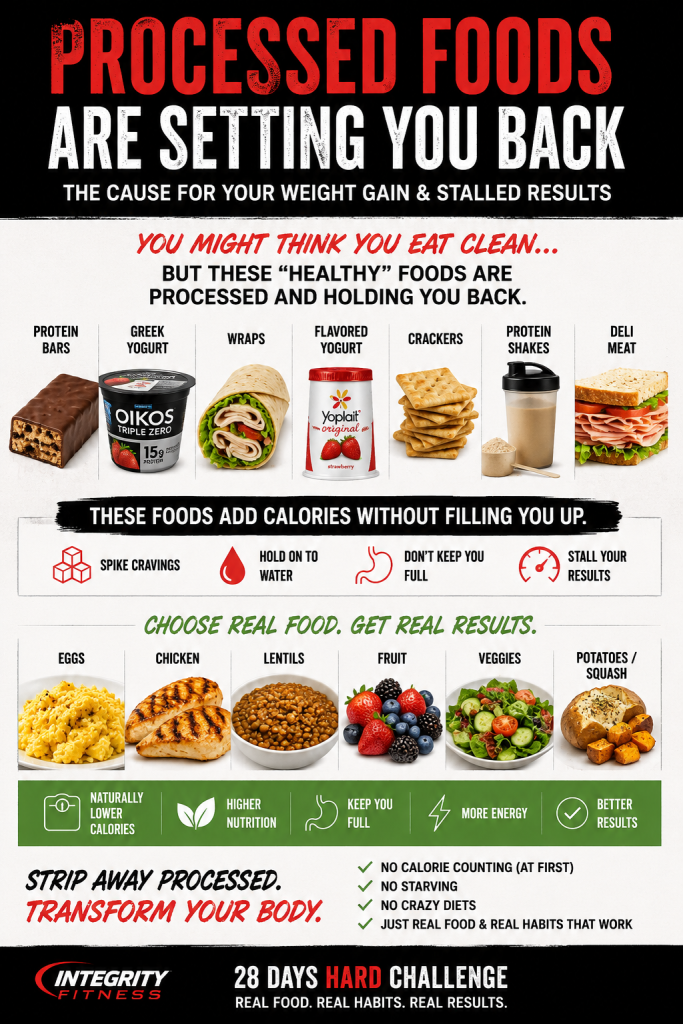
Think about your daily routine. Packaged protein bars, pre-mixed meal replacement shakes, flavored low-fat yogurts, commercial salad dressings, breakfast cereals, and high-protein boxed wraps are not real food. They are industrial formulations engineered in a lab.
The Stealth Processed Carbs: Rice, Pasta, and Bread
This is where the lightbulb finally goes on for my clients. They ask me, “But Paul, how are things like white rice, pasta, or a slice of whole-wheat bread considered processed? They don’t look like junk food.”
Let’s look at the physics of how these foods are manufactured. To make white rice or white pasta, the grain is aggressively milled to completely strip away the outer husk, the bran, and the germ. What is left behind? Just the pure, starchy endosperm.
When you strip away the fiber and natural matrix of a food, you completely change how your body processes its energy. In a whole food, fiber acts as a natural structural speed bump for your digestive system. It forces your stomach to work, slowing down the release of sugar into your bloodstream. Without that fiber speed bump, white rice, pasta, and bread break down into simple sugars almost instantly upon hitting your stomach.
Your body does not care that the glucose came from an expensive box of organic pasta or a high-end loaf of artisanal sourdough bread instead of a bag of candy; your metabolism just sees a massive, immediate rush of sugar. This triggers a sharp insulin spike.
Insulin is your primary storage hormone. When it spikes hard and fast, it acts like a biological padlock, completely shutting down your body’s ability to burn stored body fat for fuel. Worse, that massive spike forces your blood sugar to crash rapidly a couple of hours later. That predictable blood sugar crash is exactly what sends you right back into the kitchen, riding an emotional roller coaster of intense cravings, looking for another quick snack.
The Real Danger: The Bread & Topping Avalanche
Let’s address the single biggest culprit in the modern diet: bread. All bread—including sourdough, whole grain, sprouted grain, and “healthy” high-protein loaves—acts as a massive metabolic trap.
First, because it is pre-ground and highly refined, it is incredibly calorie-dense, low in volume, and exceptionally easy to overeat without ever triggering your stomach’s physical fullness sensors.
Second, and more importantly, bread rarely travels alone. Think about what automatically goes on top of or inside it. It becomes a vehicle for highly processed deli meats packed with hidden sodium and preservatives, sugary store-bought jams, commercial peanut butters or chocolate spreads, and processed cheese slices.
What started as a simple, seemingly innocent slice of bread instantly transforms into a massive, calorie-dense avalanche of hidden sugars, inflammatory oils, and additives. The calories add up incredibly fast before you even realize what hit you. By cutting out the bread completely, you don’t just eliminate the refined wheat; you automatically eliminate all the toxic, processed toppings that ride along with it.
It’s a Reset, Not a Restriction
When I tell women to eliminate processed foods and dairy from their lifestyle, their immediate fear is that they are going to starve. They think they are entering a phase of miserable deprivation.
But the reality is completely the opposite. It’s a reset, not a restriction. By switching to a base of pure, single-ingredient whole foods—like lean poultry, wild fish, eggs, sweet potatoes, squash, and green vegetables—you aren’t starving. You are finally giving your body foods that naturally regulate appetite. Whole foods contain water volume, intact fiber, and dense micronutrients that signal your brain through physical stretching of the stomach wall and the release of natural satiety hormones (like leptin and peptide YY) to tell you that you are genuinely full.
When you eat real food, your body naturally down-regulates its hunger. We don’t even touch or worry about tracking macros or counting calories until the very last week when we want to drop that final bit of excess water weight for peak results. The rest of the time? It is just clean, real, honest food. You eat until you are satisfied, and you let the food do the work.
The Habit Loop: Forcing Food “Presence”
To make this change permanent, you have to realize that weight loss isn’t just about changing what is on your plate; it is about changing how your brain interacts with food.
Right now, your eating habits are running entirely on a mindless autopilot loop. You walk through the door after a stressful, exhausting day at work. Your mental energy is completely drained. Without even thinking, you walk into the kitchen, open the cupboard, and start grazing on things like seed crackers, a handful of pretzels, or a protein bar while you figure out dinner. You aren’t processing what you are doing; you are just consuming food to soothe stress or fatigue.
When you make the definitive choice to transition to a 100% whole-food lifestyle, you immediately smash that autopilot switch.
Think about the logistical reality: if you are committed to only eating pure, single-ingredient whole foods, you can no longer just mindlessly reach into a cardboard box or a plastic wrapper and start shoving food into your mouth. You can’t just grab a raw sweet potato, a raw chicken breast, or a head of broccoli and eat it standing up at the pantry. You actually have to stop, put a pan on the stove, and prepare your meal.
Suddenly, the act of eating becomes a deliberate, intentional choice. It requires a step of preparation. It becomes a chore.
And that “chore” is your greatest psychological weapon. By forcing food to require a step of physical preparation, you break the mindless consumer habit loop. You are forced to become completely present in the moment. That brief window of friction forces you to pause, step back, and ask yourself the honest coaching question: “Am I actually physically hungry right now, or am I just bored, stressed, lonely, or tired?” This presence strips away the power of emotional triggers, transforming you from a reactive eater into a conscious designer of your own health.
Take the Invisible Brakes Off Your Metabolism
If your progress has hit a wall and you feel like you are doing everything right but the scale won’t budge, listen to me closely: it’s rarely a lack of willpower holding you back. You don’t need more discipline, and you don’t need to punish yourself with endless hours of cardio. It is the hidden elements engineered into processed foods—the stealth sugars, the refined oils, the excess sodium, and the chemical preservatives—that are keeping your cellular biology inflamed, disrupting your gut microbiome, and forcing your body to hold onto excess fluid retention.
This isn’t about chasing absolute perfection or living a life of boring isolation; it’s about building consistency, structure, and deep awareness. When you strip your nutrition back to real, single-ingredient food, and lean into a highly supportive community of women fighting for the exact same goals, you take the invisible brakes off your metabolism. Strip it back to basics, trust the power of real food, and watch how quickly your body responds.
To your health and strength,
Paul Walker Owner & Head Coach, Integrity Fitness
SHARE POST: