On This Page:
Group Reformer Pilates
Start with a $10 introductory session. Train with only two to four women and receive focused coaching in Woodbridge.
Need Help Choosing the Right Program?
Tell us about your goals, experience, and preferred training style?
Our team can help you explore Reformer Pilates, strength training, personal training, Clinical Pilates, Active Rehab, and other women’s fitness programs.

Almost everyone experiences pain at some point in life. Maybe it’s a sore shoulder that never quite settles down, nagging back pain after sitting all day, or knees that ache every time you climb the stairs.
The first question to ask is simple:
Is it acute pain or chronic pain?
Understanding the difference can completely change how you approach recovery.
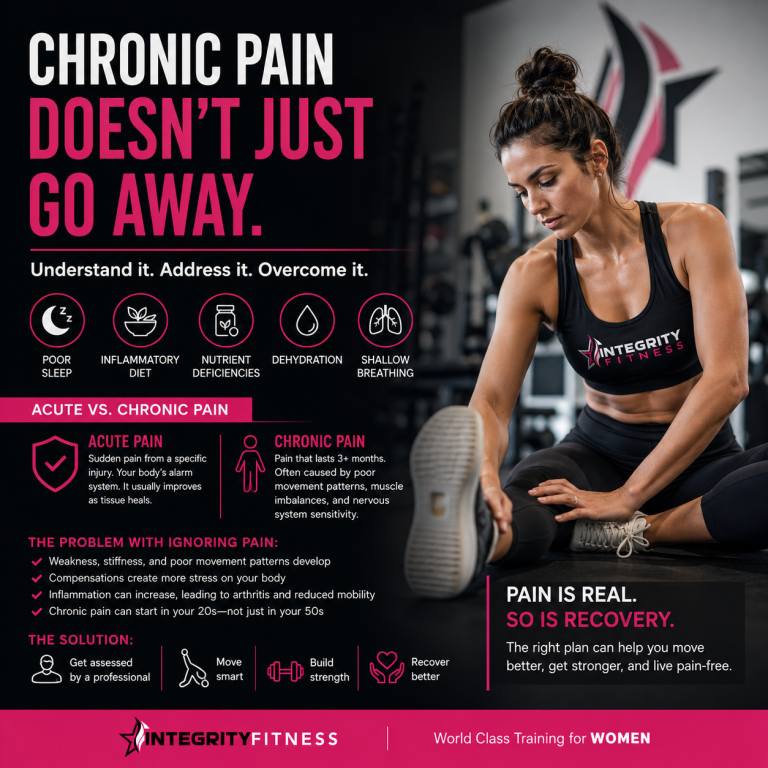
Acute Pain vs. Chronic Pain
Acute pain is your body’s alarm system. It happens after a specific injury, such as rolling your ankle, straining a muscle, or lifting something awkwardly. It’s your body’s way of saying, “Protect this area while it heals.”
Acute pain usually improves over days or weeks as the injured tissue repairs itself.
Chronic pain, on the other hand, is pain that continues for more than three months or persists beyond the normal healing time. Often, the original injury has healed, but the pain remains because the body has developed unhealthy movement patterns, muscle imbalances, stiffness, weakness, or increased sensitivity within the nervous system.
This is why two people can have similar MRI findings but completely different pain levels.
Pain isn’t always just about damaged tissue—it’s about how your body and brain are responding together.
Why Rest Isn’t Always the Answer
One of the biggest misconceptions is that chronic pain simply needs more rest.
While rest is appropriate immediately after many acute injuries, too much rest during chronic pain often makes the problem worse.
When we avoid movement:
- Muscles become weaker.
- Joints become stiffer.
- Balance and coordination decline.
- The body compensates by moving differently.
Over time, these compensations create even more stress on other joints and muscles, causing the pain cycle to continue.
Movement—when prescribed correctly—is often one of the most powerful treatments available.
What Keeps Chronic Pain Alive?
Research continues to show that chronic pain is rarely caused by one single issue. Instead, it’s often the result of several factors working together.
Some of the biggest contributors include:
- Poor sleep that limits recovery
- Chronic stress
- An inflammatory diet
- Dehydration
- Vitamin and mineral deficiencies
- Weakness and poor movement mechanics
- Sitting for long periods
- Repetitive movement patterns at work or home
Many people focus only on where it hurts, when they should also be asking why it’s hurting in the first place.
Why Professional Guidance Matters
This is where experienced healthcare professionals become valuable.
A physiotherapist, chiropractor, massage therapist, or qualified strength coach doesn’t simply chase the painful area—they look for what’s causing it.
Sometimes your sore knee actually starts with poor hip strength.
That tight shoulder may be related to your upper back mobility.
Low back pain might have more to do with weak core muscles, prolonged sitting, or limited hip movement than the back itself.
Finding the underlying cause is what creates lasting improvement.
The Long-Term Cost of Ignoring Pain
Many people learn to live with pain.
“I’ve had this shoulder for years.”
“My back always hurts.”
“My knees are just getting older.”
The problem is that chronic pain often changes how you move without you realizing it.
Those altered movement patterns can increase stress on joints over time, potentially contributing to reduced mobility and, in some cases, the progression of degenerative joint changes such as osteoarthritis. While arthritis has many contributing factors—including age, genetics, previous injuries, and body weight—moving well and staying strong can help reduce unnecessary stress on the joints.
The earlier you address the problem, the easier it usually is to correct.
Exercise Isn’t the Enemy
Many people become afraid to exercise because they’re in pain.
Ironically, appropriately prescribed exercise is one of the most evidence-supported treatments for many chronic musculoskeletal conditions.
The key is finding the right exercises, the right intensity, and the right progression.
That often means modifying movements rather than avoiding them altogether.
The Bottom Line
Pain isn’t something you should simply accept as part of getting older.
Whether you’re 25 or 65, chronic pain deserves attention—not because movement is dangerous, but because the right movement is often part of the solution.
If you’ve been dealing with ongoing aches and pains for months, don’t just hope they’ll disappear. Get assessed, identify what’s driving the problem, and build a plan that helps you move better, get stronger, and regain confidence.
Your goal shouldn’t just be living with less pain.
It should be living with more strength, better mobility, and the freedom to do the things you love for years to come.
SHARE POST: